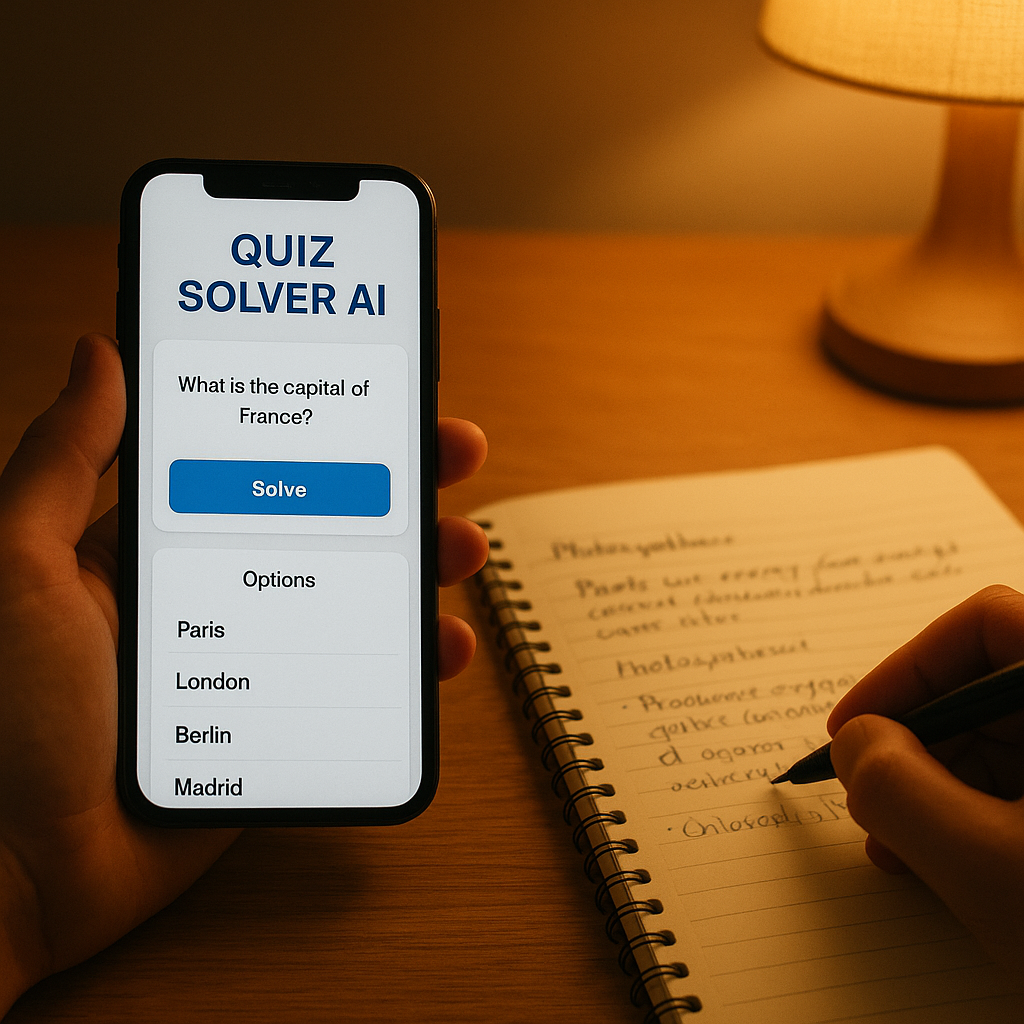
I still remember cramming for finals with a stack of color-coded notes and a sinking feeling that I’d forget everything by Monday. Sound familiar? These days, you can balance that old-school comfort with tools like Quiz Solver AI to actually learn faster — not just score a short-lived A.
Why both? Because tools that give answers instantly are tempting, but they don’t automatically build durable knowledge. On the flip side, the so-called "Traditional Study Methods" — note-taking, rereading, and manual practice — are solid but slow and sometimes inefficient. What if we stopped treating them as enemies and started combining them? Let’s walk through a practical, student-focused plan that blends the best of both worlds.
The old way vs the new way: a quick reality check
Here’s a simple comparison to get us grounded.
| Approach | Strengths | Weaknesses |
|---|---|---|
| Traditional Study (notes, rereading, manual drills) | Builds understanding, tactile memory, low tech | Time-consuming, can be passive (rereading), inconsistent review |
| With AI (Quiz Solver AI, instant feedback, auto-answers) | Fast answers, can generate practice questions, saves time | Can create dependency, may encourage shortcuts |
Not rocket science, right? The trick is to make AI an intelligent assistant rather than a crutch.
A student-friendly workflow: mix, don’t replace
Here’s a step-by-step routine I actually use — and yes, I procrastinate sometimes too.
- Skim and capture: Spend 20–30 minutes reading the chapter or watching the lecture. Jot down key concepts in a notebook or an app.
- Generate questions: Convert your notes into 10–15 questions. You can try this manually first; it forces
active recall— which is gold. If you’re stuck, use Quiz Solver AI to turn bullet points into question prompts, then tweak them. - Self-test quickly: Answer the questions without looking. Mark what you missed.
- Make flashcards: For the missed items, create flashcards (Anki, Quizlet, paper cards). Tag them by difficulty.
- Spaced repetition: Use a schedule (
1 day, 3 days, 7 days, 14 days) or an app withspaced repetitionbuilt in. - Use AI for targeted practice: Ask Quiz Solver AI for explanations, alternate examples, or to create a 10-question quiz on a weak topic.
- Final manual practice: Do timed practice tests or write short essays without AI help.
This flow keeps your brain doing the heavy lifting while AI speeds up the parts that usually eat time.
Specific combos that work
-
Flashcards + Quiz Solver AI: Make a card, try to answer, then use Quiz Solver AI to check and expand your answer. If the AI gives more context, add a follow-up card.
-
Spaced repetition + manual recall: Use
spaced repetitionfor facts and formulas. For deep concepts, schedule short teaching sessions where you explain the idea to a friend (or to yourself, aloud). -
Practice tests + AI feedback: Take a practice test cold, grade yourself, then ask Quiz Solver AI to explain each mistake. Don’t let the AI just give you the right answer; ask it to walk through why an answer is correct.
Short example: studying for Biology
Say you're reviewing cellular respiration. You read the chapter, then write 12 questions like "What are the steps of glycolysis?" and "How does ATP yield differ between aerobic and anaerobic respiration?" You attempt answers, make flashcards for the ones you missed, and schedule them in an SRS app.
Next day, you ask Quiz Solver AI to create a 10-question quiz on glycolysis that includes diagram-labeling prompts. After taking it, you use the AI’s explanations to refine your flashcards and write a 3–4 sentence summary — which is a tiny bit of production that cements understanding.
Guardrails: avoid common AI traps
- Don’t use AI to do your first pass. Writing the initial notes yourself forces focus.
- Don’t chase perfect explanations; aim for clarity. If AI gives jargon-heavy answers, ask for a version "explained like I’m 12." That’s often more effective.
- Audit AI output. Sometimes it “hallucinates” specifics. Cross-check equations, dates, and critical facts with your textbook or teacher.
A few quick tactics that save hours
- Batch question creation: Turn one study session into 20-30 usable questions you can reuse later.
- Tag cards by concept and exam weight ("high", "medium", "low"). Prioritize high-weight items in spaced reviews.
- Use the Feynman trick: explain the topic in simple language; if you can’t, you haven’t understood it yet.
Tools and terms to know
Active recall: testing yourself rather than re-reading.Spaced repetition: increasing intervals between reviews to combat forgetting.- SRS apps: Anki, Quizlet.
- AI helpers: quiz-generation, instant explanations, paraphrasing for summaries.
Final thought — why this combo beats extremes
Relying only on the old methods can be slow and demotivating. Relying only on AI can leave gaps and create brittle knowledge. When you blend both, you get speed plus durability. You still learn deeply, but you don’t waste time reinventing the wheel.
So next time you open your notebook, ask: do I need the answer now, or do I need to understand it for the long run? Use Traditional Study Methods for structure, and add Quiz Solver AI where it multiplies your effort — not replaces it. Try it for a week and notice the difference. You might actually enjoy studying a bit more. Who knew that was possible?